
English
What is the Intent of our English curriculum?
Our mission is to inspire our students to foster a genuine love for English and to use literature as a vehicle to explore their own identities and values. We hope to nurture our students to becoming lifelong learners through experiencing successes by engaging in their study of English.
The curriculum celebrates many rich and diverse forms of fiction, non-fiction, oracy and media, to reveal to our students the breadth and beauty of human creativity. We aim for our students to identify and see themselves in the texts we study, to help them develop a sense of self in the world.
It is also our mission that our students leave Braunton as fully literate individuals, who are well versed and confident both in written and spoken communication. Mastery of both the spoken and written language enables our students to enter their journeys into adulthood and the wider world with confidence and the skills to flourish.
“be audacious. I would encourage teachers to be brave and creative, to use your subject expertise to design curriculums that will set pupils’ minds alight”. English teachers can inspire pupils and at the same time ensure that they are successful in exams. You can have your cake and eat it – you just need to use the right recipes.”
Sarah Hubbard HMI and National Lead for English
How do we deliver our curriculum?
-
In Years 7 & 8 we build on the key concepts, knowledge, skills and understanding acquired at KS2.
-
We are passionate about reading and start Year 7 by launching our Sparx Reader programme, working closely with the school library. Years 7-9 experience engaging fiction, stimulating poetry and the progression to more challenging Shakespeare and non-fiction texts. Throughout, we encourage creative responses and the application of knowledge through individual and group work, and spoken presentations.
-
Year 9 is both a culmination of KS3 and a foundation to KS4. By this stage students are able to tackle highly thought-provoking and seminal texts. Teachers will encourage personal and perceptive responses from students through targeted questioning in the classroom, structured group discussions and exam-style responses. Students in Year 9 will take part in a formal in-class debate and are invited to independently study a selection of poetry, making links and comparisons, and deepening their knowledge of grammatical and poetic terminology.
-
Literacy is a vital construct in English and across the curriculum, and in key stage 3 is supported through fortnightly SPaG lessons and whole-class reading in tutor time.
-
In Years 10 & 11 all students take GCSE English Literature and English Language, which includes a Spoken Language Endorsement, revisiting and consolidating the concepts, knowledge, skills and understanding established at KS3.
-
Well-constructed schemes of work following the 21st Century Trivium model and planning across both key stages provide a framework for progression and challenge.
-
We employ a range of metacognitive and cognitive strategies to meet the learning demands of the curriculum.
-
Regular formative and summative assessment provide key opportunities for feedback to inform students of their next steps in learning.
-
Opportunities are built into the curriculum for students to develop independence, resilience and perseverance, and throughout, students are encouraged to reflect on their growth and place in the world, and their responsibilities to other people and our world.
-
Enrichment opportunities such as author visits and workshops, theatre trips and drama performances in school, Carnegie Award Shadowing, and Youth Speaks are made available to all students.
What is the impact of our curriculum?
-
Students will have acquired the knowledge, skills and understanding in English to ensure that they enjoy and make good progress in their learning.
-
Data tracking in each academic year will identify the progress of individual learners and key groups, and will trigger appropriate interventions if required.
-
Regular moderation at KS3 will ensure that students are making good progress.
-
We expect that all students will sit both English Language and English Literature GCSEs.
-
Detailed analysis of English Language and English Literature GCSE (and equivalent) courses will inform future planning, teaching and learning.
-
Annual departmental reviews, including work scrutiny, will establish strengths and weaknesses leading to RAG-rated departmental development plans.
-
Regular reflection on the appropriateness of the curriculum will ensure teaching, learning and assessment is appropriate and challenging.
-
Monitoring ‘engagement in learning’ outcomes will reveal students’ attitude and motivation towards their learning as being good or better.
Year 7
Big Idea: Exploration and identity
Core Content
Autumn 1: A letter of Introduction
Baseline assessment: Write a detailed letter describing one memory in creative and imaginative detail.
Autumn 1: The Odyssey
Study of The Odyssey
- Read, enjoy and respond to The Odyssey.
- Introduce and embed the ability to identify and interpret explicit and implicit info.
- Support ideas with textual reference and quotes.
- Introduce and embed the skills needed to analyse language and evaluate texts
- Introduce analytical writing skills in the form of WHW
- Introduce evaluative skills responding to ‘to what extent do you agree’ questions.
Autumn 2 Fiction: Beneath the Surface
Study a range of Fiction extracts focused on characterisation.
- Read, enjoy and respond to a range of fiction texts.
- Continue to embed the ability to identify and interpret explicit and implicit info.
- Support ideas with textual reference and quotes.
- Introduce and embed the skills needed to analyse language and evaluate texts
- Introduce analytical writing skills in the form of WHW
- Continue to develop evaluative skills responding to ‘to what extent do you agree’ questions.
Spring 1: Beyond Borders
Poems on identity
Study of poetry from a range of cultures
- Explore what cultural identity is and the values we and others place on it.
- Read and analyse a range of poems which explore a diverse range of cultures.
- Analyse how cultural identity is portrayed in the poems.
- Embed the skills needed to analyse poetry.
Spring 2: Creative writing
Work in progress
Summer 1: Shakespeare: All the World’s a Stage
Study a range of Shakespeare’s plays
- Henry V
- Macbeth
- Tempest
- Read and enjoy some of Shakespeare’s famous persuasive speeches from a range of plays.
- Develop an understanding of Shakespearean context.
- Understand the main different genres of Shakespeare’s plays.
- Analyse the persuasive devices employed in the speeches, teaching first two fully (Henry V and Macbeth). Use other The Tempest with lighter touch to reinforce persuasive techniques and lead in to writing phase).
Summer 2: Daring to Discover:
Study a range of non-fiction extracts focused on explorers, risks and realities.
- Develop the ability to evaluate a text critically
- Build up the persuasive skills developed in the Shakespeare unit
- Develop confidence in forming and vocalising a personal opinion.
- Develop comparative analysis skills
Year 8
Big Idea: Exploring what we and others fear to deepen our understanding of the world.
Core Content
Autumn 1: Gothic Fiction
Study a range of gothic fictional extracts
- Read, enjoy and respond to a range of gothic extracts.
- Develop an understanding of the tropes of gothic fiction.
- Embed the ability to: identify and interpret explicit and implicit info.
- Support ideas with textual reference and quotes.
- Introduce and embed the skills needed to analyse language and evaluate texts
- Introduce analytical writing skills in the form of WHW
- Introduce evaluative skills responding to ‘to what extent do you agree’ questions.
Autumn 2: Gothic Creative Writing
Study a range of Gothic fictional extracts
- Develop using language and structure for effect.
- Develop the ability to write with imaginative detail.
- Develop the ability to create atmosphere and tension within creative writing
- Widen vocabulary
- Increase the accuracy of SPaG.
Spring 1: Shadows and Shrapnel
Study a range of war poetry
- Read and respond to a variety of 19th/20th Century war poems
- Analyse language, form and structure using appropriate terminology – embed use of SLICE
- Embed the skills needed to analyse poetry.
- Develop analytical writing skills
Spring 2: Journey’s End
Study a WW1 play exploring the burdens of heroism
- Read, enjoy and respond to the play Journey’s End.
- Develop the skills of analysing character development
- Embed the skills needed to analyse a play.
- Deepen understanding of the context of WW1.
- Explore the concepts of masculinity and heroism
- Develop thematic analysis skills
MTA: How is heroism portrayed through the character of Stanhope?
Summer 1: The Tempest
Work in progress
Summer 2: Edge of Human Comfort: Exploring Human Limits.
Study a range of non-fiction exploring the human limits of comfort
- Introduce and embed ability to: identify and interpret explicit and implicit info.
- Support ideas with textual reference and quotes.
- Introduce and embed the skills needed to analyse language and evaluate texts
- Develop persuasive writing skills and writing creatively using the non-fiction medium
- Develop comparative analysis skills.
Year 9
Big idea: Knowing our principles and morals allows us to stand for what we believe in.
Autumn 1: Dystopian Fiction
Study a range of dystopian fictional extracts
- Read, enjoy and respond to a range of dystopian extracts.
- Develop an understanding of the tropes of dystopian fiction.
- Embed the ability to: identify and interpret explicit and implicit info.
- Support ideas with textual reference and quotes.
- Introduce and embed the skills needed to analyse language and evaluate texts
- Embed analytical writing skills in the form of WHW
- Introduce evaluative skills responding to ‘to what extent do you agree’ questions.
Autumn 2: Dystopian Creative Writing
Study a range of dystopian extracts
- Develop using language and structure for effect.
- Develop the ability to write with imaginative detail.
- Develop the ability to create atmosphere and tension within creative writing
- Widen vocabulary
- Increase the accuracy of SPaG.
Spring 1: Corrupting Forces
Poetry abuses of power.
Study a range of poems exploring variations of power and power misuse
- Analyse language, form and structure using appropriate terminology – embed use of SLICE
- Embed the skills needed to analyse poetry.
- Develop analytical writing skills
- Develop comparison skills
Spring 2: Dark Whispers: Secrets of the Weird Sisters
Study the witches’ scenes from Shakespeare’s Macbeth
- Understand and enjoy the plot of the whole play
- Read/analyse some key extracts from the play
- Analyse the presentation of the witches in key scenes
- Develop a deep understand of the Jacobean beliefs surrounding the supernatural
Summer 1: Fear Authority and the Human Condition
Paired article and speech study.
- Introduce and embed the ability to: identify and interpret explicit and implicit info.
- Support ideas with textual reference and quotes.
- Introduce and embed the skills needed to analyse language and evaluate texts
- Develop persuasive writing skills and writing creatively using the non-fiction medium
- Develop comparative analysis skills
- Develop the ability to form and communicate an opinion
Summer 2: Animal Farm
Work in progress
GCSE Courses
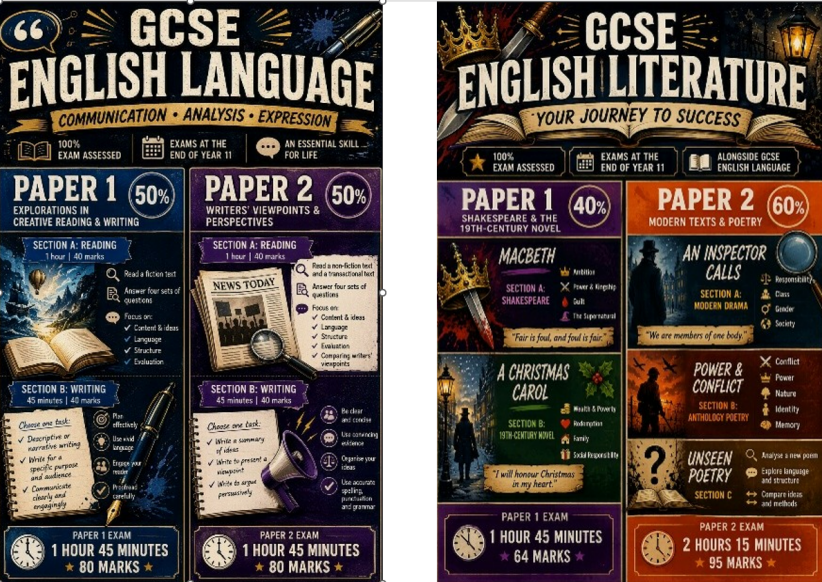
At Key Stage 4, all students study the AQA exam board for English Language and English Literature, resulting in two GCSEs at the end of Y11, graded 9-1.
Both subjects consist of two exams each, as follows:
English Language Paper 1: Explorations in Creative Reading and Writing (1 hour and 45 minutes; 50% of the GCSE)
What’s assessed?
Section A: Reading - one fiction extract (19th century or post-1900)
Section B: Writing - descriptive or narrative writing
English Language Paper 2: Writers’ Viewpoints and Perspectives (1 hour and 45 minutes; 50% of the GCSE)
What’s assessed?
Section A: Reading - one non-fiction text and one literary non-fiction text (19th century or post-1900)
Section B: Writing - to present a viewpoint.
English Literature Paper 1: Shakespeare and the 19th-century novel (1 hour and 45 minutes; 40% of the GCSE)
What’s assessed?
A Shakespeare play (currently Macbeth)
A 19th-century novel (currently A Christmas Carol)
English Literature Paper 2: Modern texts and poetry (2 hours and 15 minutes; 60% of the GCSE)
What’s assessed?
Modern prose or drama texts (currently An Inspector Calls)
A poetry anthology (currently the AQA Power and Conflict anthology)
Unseen poetry
Homework and Independent Learning
KS3 Homework
Week A: Sparx Reader. This helps students develop their reading comprehension skills.
Week B: A writing task in their homework booklet. Students receive a booklet for each unit of study.
KS4 Homework
Year 10
Homework will be set by the class teacher once a week.
Year 11
The majority of Year 11 homework will be centred on their Essay Planning Homework Booklets. To help prepare students for planning and writing essays in their examinations, homework will focus primarily on essay planning.
At times, teachers may set alternative homework tasks to meet the specific needs of their class.
Extra-curricular and Enrichment Opportunities
-
Carnegie Book Award Shadowing
-
Competitions
-
Annual Kindle draw for word-millionaires
-
Enrichment and activity days
-
Theatre trips
-
Drama performances in school
-
Author visits
-
Workshops by external providers
Useful links
For students in Years 7-9:
For students in Years 10 & 11:
BBC Bitesize GCSE English Language
BBC Bitesize GCSE English Literature
BBC GCSE/National 5 English Language

 encompass
 plastic free schools
 Teacher ambassador
 Learning cooperative trust
 Ofsted logo
 Youth Sport
 School Games Gold Award
 Smartphone Free School